Your customers can tell the food is fake
Generated food photos have become the internet's favourite thing to mock. Diners spot them at a glance, and research suggests a near-perfect fake puts people off more than an obvious one. The fix costs nothing and takes an afternoon with your phone.
Someone described a generated pizza as looking like “an alien trying to make pizza without understanding its core principles.”
It is a good line, and it has been doing the rounds for a reason. This autumn, picking apart restaurant menus with fake food on them has become a small genre of its own: sandwiches that look cartoonish, prawns curled into perfect doughnuts, ice cream scooped into exact spheres, cheese with bubbles arranged like a pattern. One diner, asked about it on camera, put it plainly:
I feel like it’s really inauthentic and it doesn’t make me wanna go eat at your restaurant.
That last part is the whole problem. The picture exists to make someone hungry. It is doing the opposite.
Why people can tell, even when they can’t say why
There is a reason these images all look alike, and it is not that the tools are bad.
They learned from an enormous pile of food photography that already shared one look — glossy, centred, flawlessly lit — and they are built to produce whatever is most pleasing on average. So everything drifts towards the same smooth, round, symmetrical ideal. One person tested this by asking a tool to redo a menu image a hundred times in a row; with every pass the food got rounder and smoother until the result was, in their words, uncomfortable to look at.
Real food is not like that. Real food is lopsided. The sauce goes where it goes. The crust browns unevenly. A real croissant has a shape no two of which agree.
People know this without ever having thought about it, which is why a generated dish reads as “off” before anyone can say what is wrong with it.
The near-miss is worse than the obvious fake
This is the counterintuitive bit, and it matters.
You would expect a better fake to be safer. Researchers who have looked at it found the reverse: food images that are almost-but-not-quite realistic triggered more disgust than ones that were obviously artificial. It is the same uncanny-valley effect people get from almost-human faces.
So the closer the generated sandwich gets to real, the more it can put people off eating it.
Why owners do it anyway
Not because they are lazy. Because it is genuinely faster.
One restaurant marketing manager explained that making a menu image this way takes five or ten minutes, against the planning and scheduling of a proper photoshoot. For a café owner working sixty hours a week, that is not a small thing.
But the trade is lopsided. You save an afternoon once. Every customer who looks at the menu after that pays for it, with a small, wordless sense that something here is not quite real — which is not the feeling you want next to a price.
A marketing professor who studies this was blunt: poor generated imagery “is going to hurt your sales, it’s going to hurt your brand.” He was also fair about it, and so should we be — improving a real photo is a different thing entirely.
The line that actually matters
Here is the distinction worth holding onto, because “never use AI” is neither true nor useful.
Improving a photo of your real food is fine. Brighten it. Straighten it. Crop out the edge of the bin. Fix the white balance so the kitchen lights don’t turn everything orange. That is what any photographer does, and nobody minds.
Inventing food that does not exist is the problem. A dish you never made, a portion bigger than the one you serve, a garnish that never arrives. That is not editing — it is a promise the plate cannot keep, and the customer finds out the moment it lands on the table.
The test is simple: if the customer ordered exactly what is in the picture, would they get it?
The fair question
devkoi is an AI that builds websites, so it is reasonable to ask why it is arguing for real photographs.
Because it has been the rule here from the start. When a site needs a picture of something the owner could photograph — their food, their shop, their work — the answer is to ask them for it, not to substitute one. A stock photo of somebody else’s lasagne is worse than no photo, and a generated one is worse than that.
What devkoi can do is take the photos you send, put them in the right places, and write the description for each one from what you tell it about the dish.
What to do this week
1. Go through your menu and your website, and find the fakes. Be honest with yourself about which images are generated, or bought, or show something you no longer serve. Those come down first.
“Remove the burger and pizza images from the menu page — I’ll send real ones.”
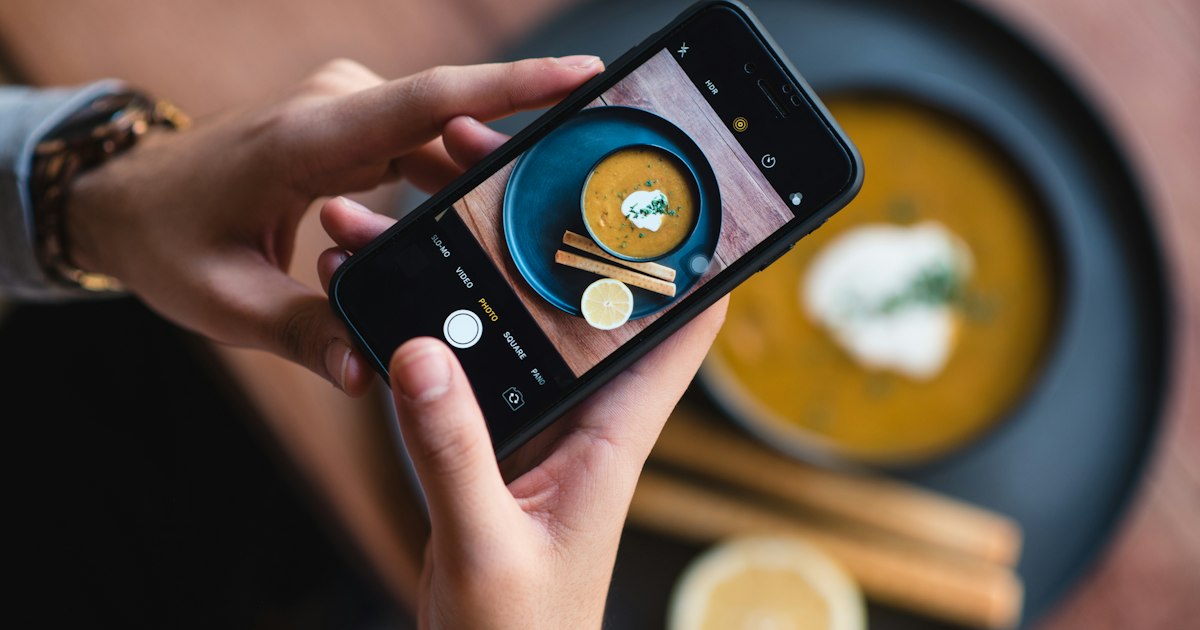
2. Shoot by a window, in daylight, with the flash off. Daylight from the side is the single biggest improvement in food photography and it is free. Mid-morning or early afternoon, next to the biggest window you have.
3. Shoot from above for flat food, from the side for tall food. Pizzas, salads, bowls and breakfasts: straight down. Burgers, cakes and anything stacked: from a low angle, roughly level with the plate.
4. One dish, a plain surface, a clean plate edge. Wipe the rim. Lose the clutter. A wooden table or a plain plate does more than any backdrop you could buy.
5. Start with your ten bestsellers. Ten honest photos of the things people actually order beat fifty of everything. You can do the rest later.
6. Edit lightly, or not at all. Brightness, straightening, a crop. Stop there. If the dish in the picture would not survive arriving at a customer’s table, it has been edited too far.
7. Send them with one line about each dish. That line becomes the image description, which helps customers using screen readers and helps anything trying to understand your menu.
“Here are ten photos. 1 is the full breakfast, 2 is the vegan bowl, 3 is the sourdough with soup…”
8. Reshoot when the dish changes. A photo of last spring’s recipe is a small lie that grows every week it stays up.
There is an odd comfort in all this. For years the advice was that you needed a professional photographer, studio lights and a budget to compete online.
The joke now going round about generated food has quietly reversed that. What customers want to see is the real plate, slightly imperfect, shot in daylight on your own table — which is to say, the one thing you can make better than any tool, in an afternoon, with the phone already in your pocket.